Semi trucks are a vehicle we see almost every day. Many young kids are fascinated by the "big cars." But the average person likely doesn't know a lot about semi trucks. For example, you might call them tractor-trailers, 18-wheelers or just trucks. In this blog, we'll answer all your basic questions about semi trucks.
A semi is a heavy-duty truck used for hauling large loads. Technically, they're Class 7 or Class 8 vehicles. For comparison, the big pickups you see pulling camping trailers are usually Class 2b or Class 3 vehicles, sometimes Class 4.
You'll see it written as semi truck, tractor-trailer, 18-wheeler, or big rig — they all refer to the same vehicle. Ready to see one in person? Browse our new and used semi truck inventory.
Why do they call it a semi truck?
It's actually a bit of a mistake to call the truck a semi. The term originally referred to the trailers. Because the trailers don't have a front set of wheels, they aren't technically trailers. So they were called semi-trailers. Over time, people started referring to the truck-trailer combo as a semi, then just the truck.
There are tons of other common names for them as well. 18-Wheeler is one of the most popular and refers to the 18 wheels that a semi typically has when pulling a trailer. Tractor-trailer is also another term you may hear a lot. All of these names refer to the combo of the truck and trailer, though are most commonly associated with just the truck portion.
What kinds of semis are there?
You can divide trucks into two categories: sleeper and day cab. A sleeper is used for long-haul trucking because it has a bedroom compartment in the back of the truck. Sleepers can be pretty basic with just a single bed and some storage. Or they can get pretty fancy with two beds, a minifridge and microwave, TV and surround sound, and more! That may sound like a lot for a truck, but drivers can spend a week or more living in their truck, getting out only for bathroom breaks and to fill up the tank.
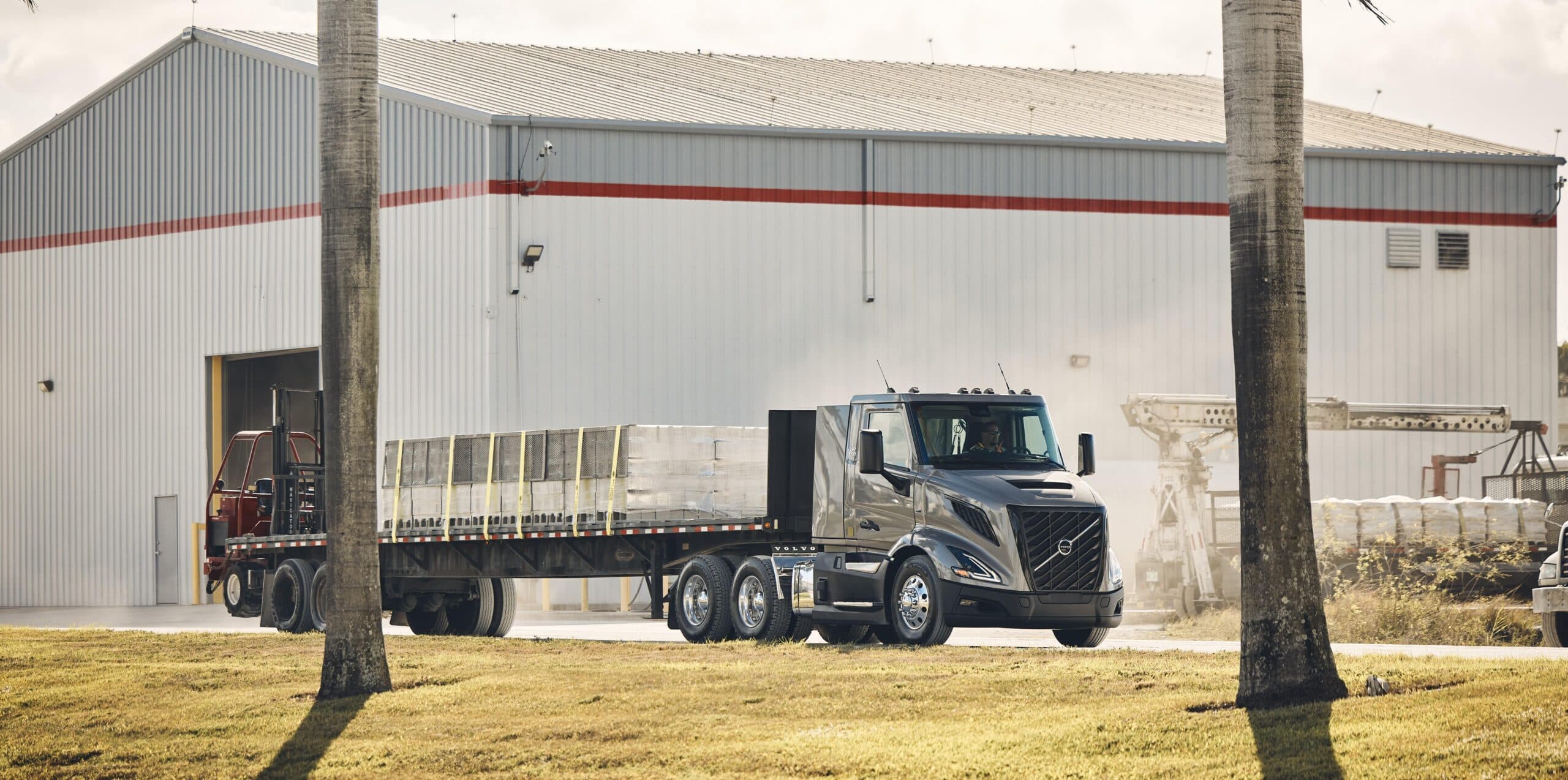
A Volvo Day Cab Truck
A day cab is just a big truck without the sleeping area. These trucks are used for shorter distances where the driver gets to go home at the end of his shift. You often see day cabs at distribution centers, ports, and even airports. Wherever there is a high volume of things shipped, you'll often see day cabs around.
You can have high-roof, mid-roof or flat roof trucks. High-roof trucks have the tallest roof possible, giving the driver plenty of room to stand up. High-roof trucks can be over 8 feet high inside. Mid-roof trucks are usually around 6 ft 9 inches inside. Flat-roof trucks are around 5 feet tall inside. These features determine how comfortable the driver will be while living in the truck, but also impact what you can pull with that truck and where you can go. Low bridges, tunnels and other road features mean tall vehicles can't take some roads.
How much does a semi weigh?
That answer varies a lot depending on the make and model of the truck as well as the engine in the truck. Day cabs (the ones without beds) generally weigh around 15-16,000 pounds, around the same as two adult Asian elephants. Small sleepers (the flat roof ones) are about 1,000 pounds more. That's like putting a polar bear on those elephants. Large sleepers can weigh over 18,000 pounds.
Nope! The trailer attaches to the truck with a large pin, called a king pin, that's usually 2-3 inches thick sticking out of the underside of the trailer. Imagine a water bottle-sized solid steel pipe. The king pin goes through the fifth wheel, a big horseshoe-shaped piece of metal on the back of the truck, and clamps lock it in place. Tow hitches just wouldn't be strong enough to pull a full trailer. Fifth wheels also bring the weight of the front half of the trailer right over the back wheels, making it easier to pull tall, heavy trailers.
How much does a semi cost?
As with weight, the price changes depending on the kind of truck, the engine and other features. New semis generally start above $100,000, but with more features on larger trucks, the price can get close to $200,000. Used trucks can be a great way to get a good truck at a lower price. Those are generally priced lower around $40,000-70,000. But prices can go lower or higher depending on the mileage, condition, age, make and model, and features of the used truck. Some can be as low as $10,000 for older or high mileage trucks.
Semi trucks are between 6.5 and 10 feet. The height depends on whether the truck has a higher roof on the sleeper, or a roof cap. The roof cap is a curved piece coming over the roof of the truck to make it more aerodynamic. Many day cabs have tall roof caps, allowing air to flow smoothly up the front of the truck and across the top of the trailer.
How much weight can a semi truck pull?
They pull anything over 26,000 pounds. But the maximum for many trucks is actually road weight limits. In every state, 80,000 pounds is the limit for all vehicles. That's the equivalent of 26 Prius cars! The weight also depends on the type of trailer.
What kind of trailers can they pull?
Dry van trailers are the typical rectangular box you see on the road. They are used for shipping lots of consumer goods like clothes, toys, electronics, books and more.
Refrigerated vans, or reefers, look like dry vans, but they have a big cooler attached to the front of the trailer. They are used to transport food that needs to stay cold like meat, cheese and ice cream.
A Volvo VNX towing a flatbed drop deck trailer
Then, there are flatbed trailers which can be just a flat base, or a big step, called a drop deck or step deck. These are used to transport big things that don't need to be protected from rain or wind, or things that don't fit in a van.
Another type of trailer is a tanker. There are lots of kinds of tankers. Some empty from the back, some from the bottom, some from the top. They can carry all kinds of liquid like milk or oil, but they are also used to haul things like wheat and beans.
The last common type of trailer is a car hauler. There are open and enclosed car haulers. Open car haulers are more common and used to move cars from a port or factory to a distribution point or dealership. Enclosed car haulers protect the car from any damage on the road, so they're used more for very expensive cars or custom cars, like racecars.
What's the best truck brand?
Well, that's hard to say. As an authorized Mack and Volvo dealer, we think they are some of the best performing semis on the market today. But the "best" truck is often based on opinion and the exact application.
How many wheels does a semi truck have?
A standard semi truck has 18 wheels — that's where the nickname "18-wheeler" comes from. The tractor typically has 10 wheels (2 up front, 8 on the drive axles) and the trailer has 8 more, spread across its axles. Some configurations have fewer or more depending on the trailer type and how many axles it uses.
How fast can a semi truck go?
Most semi trucks are physically capable of well over 100 mph, but almost none are ever driven that fast. Many fleets electronically limit — or "govern" — their trucks to somewhere in the 62-68 mph range to protect fuel economy, tires, and driver safety.
How many miles per gallon do semi trucks get?
Most semi trucks average somewhere between 6 and 8 miles per gallon, depending on the load, terrain, driving habits, and how aerodynamic the truck is. Well-spec'd newer trucks with good aerodynamics can reach 8-10+ mpg under favorable conditions. Curious how engine choice affects efficiency? Check out Which Volvo Engine is Right for You? or Choosing a Mack Engine for Your Truck.
How long do semi trucks last?
With regular maintenance, most semi trucks are built to run 750,000 to 1,000,000+ miles before needing a major overhaul — several times longer than a typical passenger vehicle. How long that translates to in years depends on how many miles a truck logs annually. If you're weighing a used truck's mileage against that benchmark, our buying guide for used semi trucks walks through what to look for.
Mack currently offers six engine options across its truck lineup: three everyday diesels built around the MP7 and MP8, two 13-liter flagship engines in the MP13 line, and the Cummins X10 — the newest engine in Mack’s long-running Cummins option, now offered in the redesigned Granite. Picking the right one shapes your fuel bill, your…
Volvo brings some of the most powerful yet fuel-efficient engines to the heavy-duty truck industry. When it comes time to select the diesel engine type when buying a new Volvo truck, you have options: the D11, the D13 or the D13TC. Each engine has its advantages, but whichever you choose, you can feel confident on…
Trucking is one of the hardest jobs in America, and the people doing it know that better than anyone. With a growing driver shortage now compounded by federal enforcement actions shrinking the eligible CDL pool, keeping the drivers you have has never mattered more. Replacing a single truck driver costs an average of $11,500, and…
Whether you’re an owner-operator buying your first truck or a fleet manager expanding your operation, purchasing a used semi truck is one of the most important equipment decisions you’ll make. The right truck can support profitability for years through reliable performance, fuel efficiency, and reduced downtime. The wrong truck can quickly become an expensive liability,…
Harvest season doesn’t wait. It arrives with urgency and a need for precision in timing, equipment, and partnerships. For growers, haulers, and agricultural fleet managers, every minute matters. That’s why TEC Equipment is here to serve as your all-in-one support system from the first load to the last field. Whether you’re scaling up with seasonal…